By Manisha Pantha
“We cannot stop disasters, but we can arm ourselves with knowledge: so many lives wouldn’t have to be lost if there was enough disaster preparedness.” — Petra Nemcova
I have worked in disaster preparedness and emergency health for over a decade, across Nepal and Europe, in the field and in research. And the one thing that stays with me, across every context, every system, and every after-action report, is we always arrive late to the problem. Actually, I would say, not late to the disaster but late to the preparation. And now, the risks are getting more complex.
CBRNE (Chemical, Biological, Radiological, Nuclear, and Explosive) events are rising in active conflict zones, in industrial accidents, and in deliberate attacks on civilian systems. This is not a distant or theoretical concern. Each of these conflicts places extraordinary pressure on health systems that were already fragile. Recent research reviewing 20 years of emergency medical services literature in Ukraine found that CBRNE preparedness only started appearing meaningfully in publications after 2022, after the crisis, not before it. The field was building knowledge while simultaneously responding. That is not preparedness. That is improvisation under pressure. And across those same 62 studies, the most frequently cited limitation was a simple one: lack of data, no standardized collection systems, no consistent protocols, and no shared metrics. Most of the decisions were made in the dark, during emergencies, with lives on the line.
To be honest, that gap between what we know and what we build is where people die. And it starts much earlier than the disaster itself; it starts in how we design the systems meant to respond. Which brings us back to who actually responds when a disaster hits. Whenever there is a disaster, the first line of response is always going to be local. When the 2015 Gorkha earthquake hit Nepal, 80% of survivors were rescued by community members and self-rescue. Not international SAR teams, not national forces, but the people who were already there, with whatever knowledge and tools they had. Preparedness is not an institutional responsibility that sits somewhere above you. It is the knowledge you carry into a room before the emergency starts.
So, if you are a young health professional, a researcher, or a student deciding where to focus your next five years, look at the gaps. Integrated emergency and PHC systems in low-resource settings, CBRNE preparedness in fragile contexts, standardized data collection for emergency response and rural emergency care in conflict and disaster settings. These are open, consequential, underresearched questions. The people who work on them now will shape how the next generation of disasters is managed. The research needs doing. The systems need building. The question is not whether someone will step in to do it. The question is whether it will be you, before the next crisis, who acts and makes the need impossible to ignore.
Where to start learning?
- OpenWHO – Emergency response, outbreak management, health crisis preparedness.
- The National Disaster & Emergency Management University – Disaster preparedness, CBRNE response, mass casualty management.
- PAHO Virtual Campus – Health emergency and disaster risk management.
- CBRNE Central – CBRNE-specific news, training, and research.
- UNDRR – Disaster risk reduction, policy, and the Sendai Framework.
About the Author:
Manisha Pantha is a public health researcher and epidemiologist who has spent over a decade working in disaster preparedness and emergency health systems across South Asia and is currently based in Europe, where her work has focused on Ukraine and Spain. She is an Erasmus Mundus alumna and a registered expert on the UN Women Women’s Resilience to Disasters Knowledge Hub.
This article is backed by her recent peer-reviewed research published in Frontiers in Public Health and Conflict and Health.
- frontiersin.org/journals/public-health/articles/10.3389/fpubh.2025.1691361/full
- pmc.ncbi.nlm.nih.gov/articles/PMC12505633/
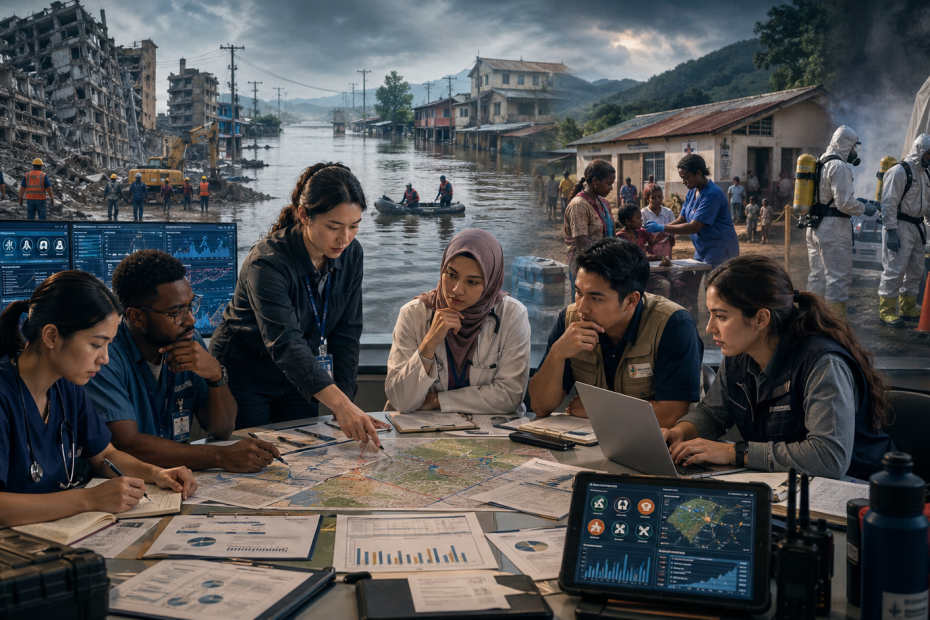
This post contains an AI-generated image for illustration purposes only.