By Excel B. Botigan
Southeast Asia’s geographic landscape and socio-political environment expose it to frequent natural hazards, including tropical cyclones, earthquakes, floods, volcanic eruptions, and droughts that often result in disasters. According to the ASEAN Coordinating Centre for Humanitarian Assistance on disaster management (AHA Centre), 1,712 disaster events were recorded in the region in 2025 alone.
While coordination has significantly improved through the AHA Centre, challenges persist in other areas of regional Disaster Management (DM). Effective DM doesn’t rely solely on coordination mechanisms but also on the consistency and quality of DM actors across ASEAN Member States. Given that each Member State has its own national disaster management organization (NDMO), differences in legal frameworks, technical competencies, and operational procedures can create challenges in regional response. These realities highlight the importance of establishing standards and a certification system that can promote interoperability and professionalism among DM actors in ASEAN.
Standards and certification can apply to various aspects of disaster management. For instance, the International Search and Rescue Advisory Group (INSARAG) certifies Urban Search and Rescue (USAR) teams, focusing on team-based operational capability for deployment. Equally important is the certification of DM professionals or practitioners at the
individual level, since they are responsible for planning, coordinating, implementing, and managing disaster preparedness, response, rehabilitation, and recovery programs.
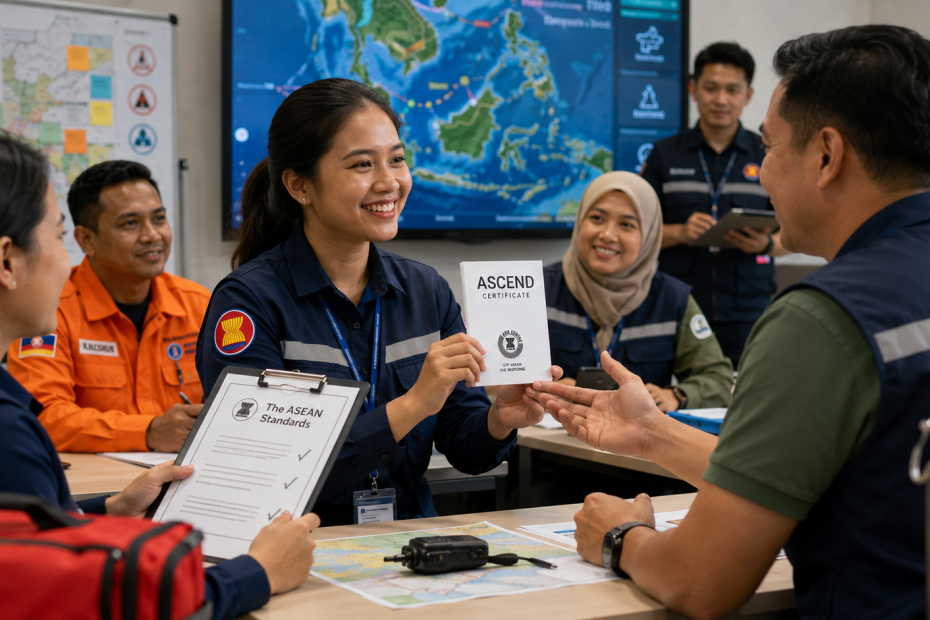
Recognizing this need, the ASEAN Standards and Certification for Experts in Disaster Management (ASCEND) Programme was developed and is now being implemented by the AHA Centre. Through common standards and competency-based certification, ASEAN seeks to ensure that DM experts and responders possess the required technical knowledge, practical skills, ethical standards, and operational experience necessary for regional deployment.
The ASCEND programme offers several benefits. First, it can improve the quality and reliability of humanitarian assistance. When human resources are certified in accordance with the ASEAN standards, affected states can be assured that deployed personnel are competent. This increases confidence in the quality of assistance being provided and may also minimize the risks associated with unqualified responders. During emergencies, affected states often operate under pressure and can be overwhelmed. Therefore, having certified responders reduces the burden of verifying the capabilities of incoming assisting personnel.
Second, ASCEND can help accelerate the mobilization of DM experts. In large-scale disasters, time is critical. While there exists a pool of trained ASEAN-ERAT, this pool can be further complemented by certified human resources who have not undergone ASEAN-ERAT training but are recognized as competent in their respective fields. This could be very helpful, especially if they are already located in the affected state and are thus familiar with the context, culture, and operational environment. This allows for quick identification and deployment of requested personnel.
Third, ASCEND supports professionalism and career development in disaster management. By establishing competency standards, the programme helps professionalize disaster management occupations as recognized fields of expertise. Certification encourages continuous learning, skills development, and adherence to ethical standards. It also facilitates knowledge sharing, which can further strengthen regional cooperation.
Lastly, ASCEND standards can serve as benchmarks for Member States that are developing or strengthening their national disaster management systems. As mentioned earlier, Member States differ in governance structures, legal frameworks, and capacities. These standards may provide a basis for harmonizing DM practices across the region, promoting a shared baseline of competence while respecting the unique contexts of each Member State.
Despite these benefits, implementing the ASCEND programme presents several challenges. For one, there is the risk that certification could be costly and less accessible as it is currently centralized at the regional level. DM professionals working at the local level, especially volunteers and community responders, may find it difficult to access certification opportunities although they possess extensive practical experience.
Another key issue is the legal acceptance of certifications. Member States have different laws, licensing requirements, and employment systems. Integrating regional certification into domestic systems may require legal changes, policy adjustments, and strong political support. Without this, certified professionals may still face administrative barriers when working across borders. Nevertheless, it is important to recognize that DM personnel often work across borders on a short-term basis as responders or humanitarian aid providers rather than as long-term regular employees. In this case, formal employment concerns stated above may not be applicable.
These implementation gaps can slowly be addressed through the localization of the ASCEND programme. However, localization itself is a challenge. For such an initiative to take place, there must be a strong buy-in from Member States. Since ASCEND is still in its early stages, its benefits are not yet fully realized or tangible, which makes it hard to generate the level of confidence and commitment needed for localizations.
In addition, financial and logistical constraints create barriers for localizing ASCEND. Organizing and providing trainings, assessments, and accreditation processes require significant funding and institutional support. Some Member States may struggle to allocate enough resources for these programs, which could lead to institutionalization and sustainability challenges. Maintaining the quality and credibility of certification systems over time also means regularly monitoring and updating standards to keep up with the evolving DM landscape.
Overall, ASCEND has the potential to greatly improve the quality and efficiency of disaster management in the region. It can help strengthen regional cooperation, professionalize the disaster management sector, and build a pool of skilled experts for increasingly complex disasters. However, the success of this programme depends on ASEAN’s ability to address capacity gaps, legal harmonization, funding, inclusivity, and long-term sustainability. If implemented effectively, regional certification can become a key part of ASEAN’s vision to build disaster-resilient communities and position the region as a global leader in disaster management.
Where to start learning?
- ASCEND Schemes & Guides – Although ASCEND registration and certification is currently by invitation only, the learner guide and relevant documents are openly accessible and available for download.
- USAR Directory – The INSARAG Search and Rescue Directory provides an overview of INSARAG member countries and their Urban Search and Rescue (USAR) teams.
- AHA Centre Weekly Disaster Update – Contains updates on significant disasters caused by natural hazard events that occurred in ASEAN Member States.
About the Author:
Ms. Excel Botigan is a disaster risk reduction and management (DRRM) practitioner currently based in the Philippines. She previously served as a project officer at the ASEAN Coordinating Centre for Humanitarian Assistance on disaster management (AHA Centre), supporting the ASEAN Standards and Certification for Experts in Disaster Management (ASCEND) Programme. She holds a Master’s degree in Humanitarian Action from University College Dublin under the NOHA Erasmus Mundus Joint Master’s Degree Programme.
References:
- ASEAN Coordinating Centre for Humanitarian Assistance on Disaster Management (AHA Centre). (2026).
ASEAN Disaster Information Network (ADINet). - ASEAN Coordinating Centre for Humanitarian Assistance on Disaster Management (AHA Centre). (n.d.).
ASEAN Standards and Certification for Experts in Disaster Management (ASCEND) Programme.
This post contains an AI-generated image for illustration purposes only.